8/23/2016

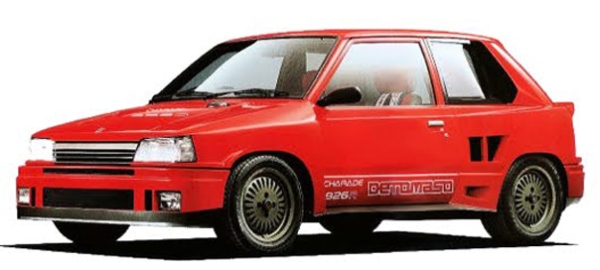
Daihatsu Charade DeTomaso 926R '1985


'Crazy little thing'

Boxy flares just the way we like it! Source: pedal2themetal.wordpress.com

Back in ’85 Daihatsu created this crazy little thing to compete in Rally’s group B –yes against those monsters, such as 205 T16 and UrQuattro... Sadly, it was about to compete in WRC in the next season, when the group B regulations were banned. Anyway, super cute and even agile, as it was based on its predecessor 926 Turbo, also developed in cooperation with De Tomaso.

Yep, it's mid-engined! Source: pinterest.com


ffdc7ab90c.jpg
Source: GtPlanet.net.


In details:

Engine  
- R3, 926cc, 12-valve, twin-cam (CB70)
- IHI RHB32 Turbocharger
Numbers
- 120hp/6500rpm

- 147Nm/3500rpm
- 800kg
Transmission
- 5 manual, RWD

- Mechanical limited splip differential
Chassis  
- Douple wishbones and coilovers in all corners
- Cambagnolo -15x6JJ front and 15x7JJ rear alloy wheels
- 205/50VR15 and 225/50VR15 tires

Exterior
- Hood with air intakes
- New pumbers
- Carello fog lamps

- Vitaloni -mirrors
- Flared front and rear fenders with intakes
- Rear spoiler
Interior
- Bucket seats

- Grey suede/red fabric trim
- 4-point harnesses
- Suede trimmed dashboard
- 6 gauges and mechanical switches for basic functions 
- MOMO -350mm steering wheel
Momo- gear knob
Other  
- One-off prototype, but a limited series of 926 Turbos are build with same engine but lesser output of 73hp
926r2.jpg
Source: GTplanet.net

3/12/2015

BMW M8 (E31) '1990

'Ultimate M-car'

Headlights are missing! Source: bimmertoday.de
BMW should have done this! In the late 80's the M-division was concepting to have this lightweight killa beast to leave all the Ferrari's standing. They bored the M70 V-12 engine to 6 liters and added experimental multi-valve cylinder head, stripped down the interior, added some neat M-style bodywork tweaks, and removed the headlights. Well, this was the case of functionality as lights were sacrificed for intakes and do you really need the headlights if other road users are usually checking your tail lights?

Unfortunately this V-12 powered M-car never made it to the production and only one was ever produced and kept in secret for many years and unveiled for the first time in 2010 at the BMW Museum. Luckily the developed engine was transplanted to 850 CSi and later to McLaren F1! The version used in 850CSi was mild but in Mac it produced first 627hp and later 635hp.
http://www.bmwmregistry.com/faq/multipart_xF8FF_2_M8.jpg
Check out the race style window opening. Source: bmwregistry.com


In details (not much):

Engine  
  - V12, 6000cc, 48-valve (s70)
Numbers
- 558hp/
 
Transmission
- 6 manual, RWD (limited slip diff)  
 
Chassis  
 
Exterior
- Removed front lights

- Hood with air intakes
- New front pumber
- DTM-style mirrors

- Race style tiny window openings and perhaps Plexiglas side windows then?
- Flared rear fenders with intakes
Interior
- Kevlar bucket seats

- 4-point harnesses  
Other  
- Only one ever made
Now that's a savage sight! Source: bmwpower-pg.net


12/12/2014

BMW M5 (F10) '2014

'Satin speed'

Everybody knows how the new M5 looks so let's concentrate on the details instead of cool picture angles. Source: bmwblog.com
The great M5 turned 30 this year, meaning that I have been growing up almost my entire life with these magnificent pieces around ;) Maybe, that's the reason why I'm so in love with the car that also gives inspiration for keeping this blog. Can't help it, there's something absorbing in the cars that look like a family carriers, but can embrace some proper sport cars. Now it's a time for special edition, actually there hasn't been that many previously. E34 had few (e.g. Winkelhock) and E39 editions were some really light cosmetic edition, please correct me if I'm wrong. 
Exterior details. Source: livedrivelife.com
As always M5's comes with a luxury goodie list is respectable including (addition to standard model): Adaptive LED Headlights, Comfort Access with smart-opener, Competition package, Driving Assistant, Headlining, Anthracite Alcantara, Instrument panel upper and lower sections, Nappa leather, Harman/Kardon -loudspeaker system, Lumbar support ( for both driver and front passenger), M Sport multi-function seats (front), and Split-folding rear seat with additional 12 volt rear power socket. Of course you add some extra goodies, like if Harman/Kardon plays your tunes somewhat vaguely you can update to B&O advanced audio system or have M carbon ceramic brakes that costs a fortune, or how about carbon fibre covered titanium exhaust system! This extravaganza lightweight sport exhaust is developed together with Akrapovic, does just perfect justice for the Twin Power Turbo V8 sound. If that's not enough four tailpipes can be updated from 92mm to 95mm tailpipe finishers in carbon-fibre and the whole system costs only £6,890!!!
Some interior details. Source: livelifedrive.com

I have been arguing before that F10 is somewhat too large to ever appeal me in big time. The current model is huge and majority of the massive appearance comes from massive height of the doors and rear panels. Compare the old models (except the previous) and you will find out what I'm talking about. Don't get me wrong, I do like the design, but it's just too perfect: masses are in perfect harmony and details in great balance, but the 'odd' thing that makes great to magnificent and unique is missing. Same posses to M5 and especially to this SE, additional special details are just not enough special or distinguished from others like. Having all the stichings and finishers reminding you that you are driving  '30 Jahre M5' limited series are not enough from my point of view. Having an titanium Akrapovic exhaust as an option, alcantara steering wheel, and satin paint are really neat touches, but don't give uniqueness for the edition that it deserves. For example, think about the Porsche specials, like GT RS3 or latest 911 anniversary editions, in those you can spot the difference to standard models without being petrol head.
Spot the design development from agile to fatty :) Source: BMWblog.com

In details (mods to original):

Engine 
- V8,4395cc, 32-valve, Twin-turbo
Numbers
- 600hp/

- 700Nm/
- 0-100Km/h: 3,9s  
Transmission
-
Auto 7 with sequential mode, RWD (limited slip dif)  
Chassis
- 20" M Double-spoke style (601M)
- Ventilated disks (400/396mm), 6- piston clibers fromt and 1- piston rear  
Exterior
- Side gills with '30 Jahre M5' designation
- Dark Chrome tailpipes, side gills, kidney grille and door handle inserts
- BMW Individual Frozen Dark Silver metallic paintwork

Interior
- Interior trim, Dark Aluminium Trace with Dark Chrome finisher, '30 Jahre M5' and '1/300' designation
- '30 Jahre M5' stitching on front and rear seats
- Anthracite Alcantara centre console, arm rests and door pulls

- BMW Individual Black Alcantara / Full Merino leather upholstery
- Door sill finishers with '30 Jahre M5' designation
- M Sport Anthracite Alcantara multifunction steering wheel with gearshift paddles
Other
- Limited number of 300 pieces made and 30 delivered to States
- Optional: e.g. titanium Akrapovic -exhaust system, carbon exhaust tips, Competition package (7MA), comfort access sytem (322), and ceramic brakes.

11/14/2014

Saab 9-3 Viggen '1999-2002

'Thunderbolt'
http://doublejslist.com/wp-content/uploads/2011/08/saab_9-3-viggen-coupe-1999-2002_r13.jpg.jpg
Source: doublejslist.com


It has been a while since writing anything to this space. Well many things happening, for example moved to Netherlands. Which is the main reason of writing the folowing report. The amount of Saab's is crazy over here. Dunno, how is the situation in Sweden or States, but the Saab 900/9-3 cabrio ratio to other cars (not only cabrios) here is significant and I'm loving it. In my opinion Saab 900/9-3 is one of the coolest cars; can't really come up with any other car that has such a timeless design that is at the same time little weird, different from other's, and sporty, yet practical with a huge trunk.

Naturally in a name of Wolf Cars, this writing considers Viggen -the hottest model named after a fighter jet!


http://doublejslist.com/wp-content/uploads/2011/08/2001_Saab_9-3_Viggen_6.jpg
Cabrio version. Source: doublejslist.com
The original car was launched in 1998 and it looked pretty much as the previous 900, that has to do with the fact that it was based on the old model and only 1100 components were changed or improved. Viggen was the first fruit of Saab's SVO (Special Vehicle Operation) program in collaboration with TWR

 Viggen was also produced in 5 door version. Source: autogaleria.hu
Two-tone leather and center placed ignition -sweet! Source: uwwica.com
In 1999 the Viffed hitted the showrooms with a new B235R -engine having 14% higher volumetric efficiency than a Porsche 911 Carrera 3.6! The powerplant produces 230hp and Nm from 2.3 litres four cylinder with a help of turbo and intercooler. Same engine was used later in 9-5 Aero. Well, Saab is famous about it's FWD, thus the car torquesteers like a mother fucker.TWR tweaked the chassis as much as they could, but I quess with such a old design (originally from 70's) there wasn't real solutions to solve power delivery problems.
Addition to power increase and chassis tweaking the exterior and interior got some final touches to compete with it's well known German enemies. Well, it wasn't really sale success, but makes a really unique option for M3 or C AMG with it's hooligan FWD nature. We used to have Saab's in family when I practiced driving and this exceptional brand will always have a place in my heart.

BTW, Wiggen means thunderbolt in Swedish. 


In details:

Engine 
- R4, 2290cc, 16-valve, Turbo 'B235R'
- 9.3:1 compression ratio
- Custom "Trionic-7" fuel-injection system and direct-ignition  - Large oil and water-cooled turbocharger
- Maximum boost pressure of 1.4 bar,

Numbers
- 225hp/5500rpm (limiter 6300rpm)  

- 342Nm/2500-4000rpm (approx. 122-195hp)
- 0-100Km/h: 6,8s
- 0-400M: 15, 3s
- Top speed 250 Km/h - 1395Kg

Transmission
- 5 speed manual, FWD

- Upgraded clutch assemply
- Larger diameter and stronger driveshafts and strengthened CV joints
Chassis
- Stiffer springs and dampers
- Anti-roll bar in front
- Upgraded steering rack mounts - Ventilated and grooved disks (308mm) front and 287mm (grooved) disks rear - 17x7,5" exclusive 5 spoke alloys with 215/45ZR17 Dunlop tires
Exterior
- Unique bumpers and rear spoiler (reducing aerodynamic drag by 8% to a 0.31 coefficient and reducing lift forces over the rear wheels by 60%)

- Sport exhaust tip
- Exclusive 'Viggen' plates 

    Interior
- Sport seats (by Lear)
- Unique two-tone leather interior - Sport steering wheel - Extra gauges
- Custom dashboard
- Exclusive 'Viggen' plates

Other
- Limited colors awailable; blue in 1999, with silver and black added in 2000, other colors like red later
- Less than 3000 Viggens were ever made (including 3D, 5D, and cabrio versions)

3/21/2014

Lancia Delta HF Integrale Evoluzione Cabrio '1992

'Chop-top'

The original? spotted from traffic. Source: forum.auto.com
There's many good examples of Italian designers getting involved in turning otherwise boring standard cars into something interesting, such as Pinifarina and Peugeot collaborations and most of the Volvo coupes designed by Bertone. Although, Lancia Delta is a nice example of boxy design of it's era and Integrale versions are not boring at all the design of this cabrio version can not be counted on Zagato's master pieces.

From the side it's not the pretties thing. Source: Facebook
Hopefully there was only 2 cabrio Integrale's ever made. Least, other one of the ultimate rare Integrale's was made for special request for the bon vivier, Giovanni Agnelli. Outside of the two door conversion, interesting rear design, and open roof the special version is somewhat standard Delta Integrale EVO. Except the fact that the guy was handicap of the 'avvocato' and therefore the car is equipped with an automatic clutch! Apart from the sacrilege of equiping Integrale with the automatic clutch and ruined design this version must be one of the most desirable of many special edition Integrales existing. Next time you go to Torino check the car out in one of the coolest car collections of  Museo Nazionale dell'Automobile. Additionally, if you fancy have one of your own contact il Cavallino they have produces some replicas.
 
Source: photopucket.com

In details (standard Evo I):

 
Engine  

- R4, 1995cc, 16-valve, Turbo
- Garrett T03 -charger (1,0 bar)
- Intercooler
- Weber-Marelli engine management

 
Numbers
  - 210hp/5750rpm (limiter 6300rpm) - 304Nm/3500rpm - 0-100Km/h: 6,3s (claimed 5,7s) - 0-400M: 14,4s
- 0-1000M: 26, 1s - 100Km/h -0Km/h: 39, 5m - Top speed 219 Km/h
- 1340Kg

 
Transmission
  - 5 speed manual, 4WD
- Torsen rear differential - Epicyclical center differential with 47-53 % F/R torque distribution

 
Chassis
  - Independent McPherson struts lower triangle, coil springs and hydraulic shock absorbers, anti-roll bar in front
- Independent, double transverse arms, longitudinal arm coil springs and hydraulic shock absorbers, anti-roll bar in rear.
- Ventilated disks (28,1 cm) with 4-pot calibers in front and 25,1cm disks with 1-pot calibers rear
- 7x15" alloys with 205/50ZR15 tires

 
Exterior
  - Broaden wheel arches (air vents in front arches)
- Scoop and air vents in hood
- Upgraded pumpers 

 
Interior
  - Bucket seats
- Leather interior
- Sport steering wheel
- Extra gauges

1/01/2014

Wolf Escort Cosworth '1994

'In the name of Wolf'

In my A-list there will be always listed many Cosworth creations, i.e. Ford's, MB 190 2.3, RS4 etc. These magnificent wolfcars are finetuned by strongly motorsport oriented company that was founded in 50's by Keith Duckworth and Mike Costin. In my mind the name Cosworth is always linked mostly to certain Escort and Sierra models. Ford owned the company for a while and Cosworth name appears in their rally inspired special models. Although, Sierra was the 'first' Cossie and has one of the most modern looks of it's era, the white-blue and Repsol coloured Escort rally weapons of the 90's are the ones for me. Maybe Mr. Kannkkunen stole my heart back n the days?

Source: passionford.com
This story is about German based Wolf tuning company's (also known as Walter Wolf Racing) tuned Escort Cosworth. Wolf offers various tuning parts for different Ford models and Wolf Escort Cosworth is somewhat a regular model containing various Wolf tuning parts. Although, Wolf Escort is not really an limited series or special edition, like Brabus or Alpina it has gained mystique reputation in Ford forums and as the 'Wolf' appears in the name it needs to be introduced here. Actually, I don't know many Ford tuners, instead some UK based, but none of them offers comprehensive tuning kits or virtually reproduced Fords. Maybe Wolf offers the dopest conversions? Least Wolf uses the same manufacturers with their pits and kits as the Ford to keep quality in proper level and tuning pits are also sold through the Ford dealers. So basically customers are able to choose only some Wolf parts for their cars instead of complete packages. Above I have listed specs of the complete Wolf Esco Cossie.

18" Wolf/ATP wheels and front splitter. Source: rscosworth.it
Wolf rear spoiler (extension) and Remus exhaust. Source: rscosworth.it

In details:

Engine
Wolf steering wheel and gauges. Source: carpics.com

- R4, 1993cc, 16-valve
- Garrett 'T34' Turbo
- Upgraded intercooler
- Wolf ecu
- Siemens injectors
- Upgraded fuel pump
- Upgraded airflow meter
- Wolf exhaust (Remus)
- Wolf engine cover

Numbers
- 300hp/6000rpm
- 458Nm/4000rpm
- 0-100Km/h: 4,6s
- 80-180km/h: 12,5s
Wolf green extra gauges. Source: passionford.com

- Top speed 260Km/h

Transmission
- 6 speed manual, 4WD (Haldex)
- Limited slip differential 

Chassis
- Upgraded suspension (Bilstein/Eibach)
- Wolf front strutbrace
- Ventilated disks front and rear (334/26mm)
- Wolf/ATS 18x8" alloys and 235/40ZR18 tires

Exterior
- Front splitter
- Alloy fuel cap
- Rear spoiler (lower) extension

Interior
- 'Motorsport' labeled interior (similar to Martini models)
- Wolf steering wheel and gear knob
- Wolf speedo up to 300km/h
- Upgraded boost gauge (2 bars)
- Alloy pedals
- Wolf floor mats

Other
- Complete price: 86.500DM (1994)

11/15/2013

Volkswagen Harlequin '1995-96

'Dope Dub'
One of the original Harlequin Golf's with some neat touches. Source:canibeat.com
Nike Air force one's. Source:undergroundsoles.com
What happens in serious car company's assembly line when two dope heads get bored... "Chee, dude you have cool sneakers!" "Thanks bro, just stood 36 hours in line for these limited editions" "Wouldn't it be cool to have multi-colored Golf instead of these plain ones?" Yeah, would match ya shoes!" Hey man let's get busy, I have an idea, I'm sick of this shit anyway...

Based on this little trick in 1996 Volkswagen magazine ad said, “Can’t decide on a color? Try a Harlequin Golf.”  Thought, VW had difficulties to get all these 264 bizarre coloured Golf's sold and marketing department had to work their ass off before understanding the great marketing potential of these head turning creations: looks like a joke so let's call it a Harlequin and use it as a show stopper promoting different colour options and then sell it as a collectibles. 


Original ad pic. Source:rossvw.com
Not really, but almost, only the two dope heads were not involved. The original idea of the Harlequin Polo was to show that the Polo can be customimzed for your personal taste with paintwork, engine, chassis, interior, and optional equipment options.


Colour chart of the Harlequin models. Source: thetruthaboutcars.com
So, it started with Polo's back in 1995 when VW produced a limited series of 1000, but after positive feedback they procude some 2800 pieces more. Each body panel was painted with different colour: Flash red, Ginster yellow, Pistachio green and Chagall blue and cars had a "joker" interior with 90's style pattern. The Harlequins were produced by swapping the body panels of four different colored cars. They are usually designated by their base color (the color of the car with no body panels attached) and the base color is not repeated on any of the other body parts. 

After Polo's success VW decided to make the same trick in States with mk3 Golf and released the limited series that became the ultimate rare VW. Most of the Harlequin Golf's are listed in Harlequin Golf registry, maintained by the VW maniac owning five harlequin golfs and 52 Volkswagens! Seems to be that the same trick was repeated third time in Brasil with a VW Gol. All the cars are totally standard, except the colour scheme, but as Wolf cars stands for ultimate rare cars this needs to be featured.

Polo Harlequin ad. Source: polodriver.com

In details (Golf):

Engine
- R4, 1984cc, 8-valve (2E/ABA/ADY/AGG)

Numbers
- 115hp/5400rpm
- 166Nm/3200rpm
- 0-100Km/h: 9,9s

- Top speed: 210Km/h
- Coefficient of drag: 0,32

Transmission
- 5 speed manual or auto, FWD
 
Chassis
- Several different wheel options, e.g. cabrio alloys
- Discs front and drums rear

Exterior

- Limited edition Harlequin paint scheme
- U.S model bumbers and tailgate for narrow license plate

Interior
- Harlequin sport cloth seats
- Silver faced dials

Other

- Polo: Originally limited to 1,000, but most probably 3,806 produced
- Golf: 264 produced 
- Gol: ???


How about this harlequin RS4 from Woerthersee 2011? Source: peace534.pixnet.net

10/28/2013

Citroen BX 4TC '1986

'Epic Fail'
Only Frech car can have six headlights! Source: www.flickr.com
Like many others back in the 80's Citroën developed their weapon for rally's Group B. Unfortunately just as the monster made its depute the whole series was finished. Well Citroën had some leftovers from limited series lying around so they decided to go for a ultimate GT -car!

The car officially launched in 1985 and meant for the next season. 4TC basis on BX, but is far from normal and evolution version is even crazier with bigger turbo and number of radiators in the back. Both hand built specials have significant amount of headlights, terribly long nose, because the engine mounted in 90 degree angle in the front to fit. Bodywork has plastig surgeries everywhere with cool boxy styling characteristical for the era. Interior luxurious with all the equipment and very similar to BX GTI. 

Massive plastic pulges. Source: www.picstopin.com
Sales of the 4TC were disappointin and only 62 pieces were sold and those were so prone for the mechanical failures that Citroën offered to buy cars back for destruction! It's estimated that 55 examples exist and only couple are EVO's, one in Citroën's museum and another one in private collection. However three EVO -bodyshells were rescued: one is rebuild, one crashed, and one somewhere. Here's an small test drive of the car and here's the beast in duty -damn the works model is out of scale!

Best achievement of the works model was 6th place in Swedish rally.

Very rare black one. Source: www.drivecult.com

In details:


Engine
- R4, 2141cc, 16valve (downsized from Chrysler 180's and Talbot Tagora's '
N9TE' 2155cc)
- Bosch, K-jetronic
- Garrett, turbocharger
- Ait-to-air intercooler
- Compression ratio: 7:1
- Cast iron block with aluminium single-cam head
Numbers
- approx. 200hp/5250rpm (6000rpm red line) (works 380hp/7000rpm)

- 294Nm/2750rpm (works 451Nm/5500rpm)
- 0-100Km/h: 7,5s (4TC-EVO in 5,5s)
- 0-400M: 14,3s

- Top speed 220Km/h
- 1280kg
- Drag coefficient: 0,4

Transmission
- 5 speed manual (from Citroën SM), 4WD 

Chassis
-
Unique hydropneumatic suspension
- Citroën CX brakes
-
150 TR 380 FH 'Aero' alloy wheel with 210/55 VR 390 tyres

Exterior

- Six headlights!
- Massive bonnet bulge
- Fog light pattern between headlights
- Long long nose extension (because longidutial engine mounting)
- Flared wheel arches
- Special bumpers

Interior
- Dashboard with 7 dials and 20 "analog" warning lights
- 3 spoke leather steering wheel

- Extra gauges
- otherwise similar to BX GTI


Other
-
200 examples built and the dozen or so cars with two doors and a shortened wheelbase (For homologate the Group B version)
- Rumors say that only 20 or so examples survived the purge
- Purchasing prize nowadays between 40,000 euros and 60,000 euros

8/22/2013

Fiat Abarth 131 Rally '1975-81

"Stradale"

Pure RWD action! Source: 131mirafiori.com
11.000 visitors! Thank you! This milestone deserves something seriously cool. How about supercharged Fiat from the 70's with Bertone styling and Abarth race spec?

This very special thing basis on not so special Fiat 131, predecessor of Fiat 124, maybe better known as Lada. Well, basic dull car can turn something beautiful when racing department takes over. Abarth founded 131 suitable for their next rally weapon, because the large engine room, rear wheel drive, and roots in 124 that was familiar from earlier rallies. Development started somewhere in 1974 and deadline was set to 1976 season. Many prototypes was developed, were wildest one is 131 SE031 Abarth equipped with tweaked Ferrari Dino's V6 engine producing 270hp@6800rpm! After several prototypes best engine combination was chosen to be 2 litre twin cam with supercharger that was suitable for group 4 in world rally championships. Luckily, homologation for the group reguired 400 road legal units to be produced.

Boxy style beats organic lines every time. Source: 131abarth.com
Boxy aerodynamics are designed by Bertone and are able to swallow even 12 inch wide rims for tarmac use. Works car had 12/10 inch rotors with twin calibers, hydraulic hand brake, three different body strength options, and ZF's five speed gearbox with limited slip differential. The KugelFischer mechanically injected 1995cc engine produced around 220hp@8000rpm and rev limiter was set all the way up to 8500rpm! Cool figures for car weighting just 973kg.

Back in the days works and civil model didn't have much a difference... Source: 131mirafiori.com
Winning formula took rally world championship in 1977, 78, and 80! Road going versions were sold in quite customizable way and customers were able to choose from many options from works cars, especially latter models were basically build from "leftover" parts from the Abarth garage.

Check out here one happy guy driving it and introducing all the details (in Spanish?).

Road spec in details (works figures):


Engine
- R4, 1995cc, twin cam, belt driven, 16 valve, DOCH "138 AR1.000" (Abarth type 236b)
- Compression ratio: 10,1:1 (10,7:1)
- Aluminum cylinder head
- Weber 34 DMTR carbs (KugelFischer mechanical injection)
- Works model has Abarth: pistons, valve springs, head gasket, spark plugs, and larger valves
- Rotary pump sump lubrication, cap 4.1kg /cap 6.6kg)
- 4-1 exhaust

Numbers
- 140hp/6400rpm (approx. 215hp/7000rpm, max 8600rpm)
- 176Nm/3800rpm (approx. 225Nm/3800rpm)
- 0-100Km/h: 8,2s (6,6s)
- 0-400M: 15,3s (14,6s)
- Top speed 200Km/h (185Km/h)
- 980kg
- Weight distribution in works model 50/50%

Transmission
- 5 speed manual, RWD (ZF's 5 speed dog manual with limited splip)
- Final drive ratio 14/50 (between 7/43 and 11/40)
- single dry plate clutch

Chassis
- Independent McPherson front and independent wishbones rear (fully independent rear suspension) 
- Disks front (single pistons) and rear drums (12/10inch ventilated discs with dual pistons)
- Cromadora 14x7" alloys and 185/60HR Pirelli tires (15x7" alloys with 185/70 or 285/35 tires!)

Exterior
- Fiberglass exterior, except roof, doors and area between rear lights are steel
- Bumpers removed
- Rear wing
- Rear window wing
- Extended fenders
- Rain drop style mirrors
- Air intakes for rear brakes
- Bonnet scoop

Interior
- Bucket seats
- Sport steering wheel
- Rolling gage
- Extra set of gauges

Other
- 75% of parts are identical with standard models
- Approx. 400 was ever made
- Approx. 350 was sold by Italian dealers and 50 were given for Abarth for rally use
- Body parts made and fit by Bertone